
If you’re looking into dental implant surgery, this guide explains how implants work, who they help, and what to expect from start to finish. You’ll learn the parts of an implant, the surgical steps, risks and recovery, benefits versus bridges or dentures, typical costs, and how to choose a provider for dental implant surgery in Louisville.
What Is Dental Implant Surgery?
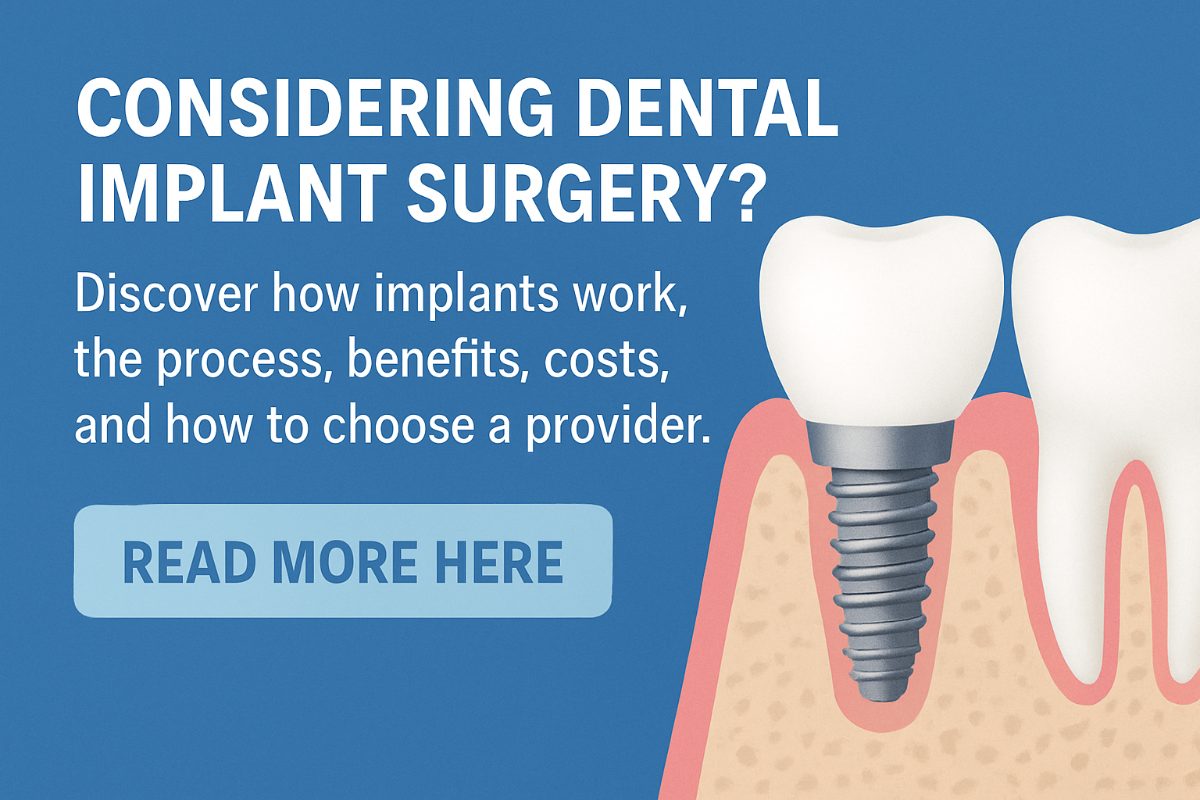
Dental implant surgery replaces missing teeth by placing a small titanium post into the jawbone to act as a tooth root. The goal is to restore chewing, speech, and the look of a natural tooth or a full arch. Implants can replace one tooth, several teeth, or support a full-arch prosthesis.
The three main parts
- Implant — the titanium post that is placed into the jawbone.
- Abutment — the connector that attaches the crown or prosthesis to the implant.
- Crown or prosthesis — the visible tooth, bridge, or full-arch denture that restores function and appearance.
Who Is A Candidate For Dental Implant Surgery?
Most healthy adults with one or more missing teeth can be candidates for dental implant procedures in Louisville or nearby areas. Key factors include:
- Good overall health — conditions like diabetes should be controlled.
- Gum health — active gum disease should be treated before implants.
- Bone volume — enough jawbone is needed; bone grafts or sinus lifts help when bone is low.
- Smoking — quitting improves success rates; some smokers can still get implants if they quit before surgery.
Age alone is not a barrier. Candidates range from adults who need one tooth replaced to patients needing full-arch restorations.
Step-by-step Dental Implant Surgery Process
Consultation and 3D imaging
The process starts with an exam and 3D imaging like CBCT scans. These scans show bone quality, tooth position, and nerve pathways. Digital impressions replace messy molds and help plan precise placement for safe, predictable results with dental implant surgery in Louisville.
Digital planning and surgical guides
Using 3D planning software, the dentist designs the ideal implant position. A 3D-printed surgical guide can direct the drill during surgery so the implant goes exactly where planned. Guided surgery reduces risk and speeds recovery.
Placement day: what happens
On the day of surgery you may get local anesthesia plus optional sedation (oral or IV). The implant is placed into the bone, and sutures may be used. Many patients leave the office with a temporary crown or denture the same day, depending on bone stability and treatment plan.
Healing and osseointegration
After placement the implant fuses with bone in a process called osseointegration. This usually takes a few months. During healing you’ll follow soft-food and hygiene instructions. Temporary restorations protect the site until the implant is stable enough for a final prosthesis.
Abutment and final restoration
Once healed, an abutment is attached and a final crown, bridge, or full-arch prosthesis is placed. With in-office milling and scanning, some practices deliver permanent restorations the same day the abutment is attached.
Risks, Recovery, and Aftercare After Dental Implant Surgery
Short-term effects include swelling, minor bleeding, and soreness. Serious complications are rare but can include infection, nerve irritation, or implant failure.
- Take prescribed pain meds and antibiotics as directed.
- Use ice, rest, and a soft diet for the first 48–72 hours.
- Keep the area clean with gentle rinses; avoid smoking during healing.
- Watch for increasing pain, fever, or pus — call your dentist if these occur.
Follow-up visits confirm healing and long-term maintenance visits help protect implant health and surrounding tissues.
Benefits Of Dental Implants vs. Alternatives
Dental implants preserve bone, feel stable, and restore chewing like natural teeth. Compared with bridges, implants don’t require cutting down adjacent healthy teeth. Compared with dentures, implants provide far better function and comfort and can last decades with good care. Bridges or dentures may still be recommended when cost, medical issues, or bone limitations make implants impractical.
Cost, Insurance, and Financing For Dental Implant Surgery
Costs vary based on the number of implants, need for bone grafts or sinus lifts, imaging, lab work, and the type of final restoration. Dental insurance may cover part of the crown or prosthesis but often has limits on implant coverage. Many offices offer financing, payment plans, or third-party medical credit to spread the cost.
Why Choose Harmon Dental Center For Dental Implant Surgery
At Harmon Dental Center, Dr. Bradley Harmon and the team provide advanced implant care with a focus on comfort and predictable results. Dr. Harmon earned his DDS with honors and maintains extensive training and professional memberships. He treats patients like family and stays current with implant techniques.
Key in-house technology that improves outcomes:
- On-site full-mouth dental implant lab for precise restorations
- Primescan® intraoral scanner for fast, accurate digital impressions
- Primemill® chairside milling for same-day crowns and restorations
- CBCT scanner for 3D imaging and safe implant planning
- In-house 3D printers to make custom surgical guides and models
- Fully equipped surgical suite with oral and IV sedation options
These capabilities let the team offer same-day restorations, fewer visits, and tighter quality control for dental implant surgery in Louisville.
Frequently Asked Questions About Dental Implant Surgery
- How long do implants last? With good care, implants often last 20 years or more and can be lifelong.
- Is the surgery painful? Most patients report mild to moderate discomfort controllable with medication. Sedation reduces anxiety and awareness during the procedure.
- What is the failure rate? Failure is uncommon — typically under 5% for healthy patients when placed and maintained properly.
- Am I too old for implants? Age alone is not a barrier. Health and bone quality matter more than age.
Scheduling A Consultation For Dental Implant Surgery
Bring any recent dental X-rays, a list of medications, and your medical history. Your initial visit includes an exam, discussion of goals, and CBCT imaging if needed. If you’re ready to learn about options and pricing for dental implant surgery in Louisville, contact Harmon Dental Center to schedule a consultation. Our team will review your plan, financing options, and a timeline tailored to your needs.