
Dental Teeth Implants: Everything You Need to Know
Dental teeth implants provide a stable, natural-looking way to replace missing or severely damaged teeth. They can support a single crown, replace several adjacent teeth, stabilize a removable denture, or anchor a fixed full-arch restoration.
Unlike a traditional bridge or removable denture, an implant replaces part of the missing tooth below the gumline. The implant post is positioned in the jawbone, where it creates a foundation for the visible replacement tooth.
This guide explains how dental implants work, who may qualify, the types of implant restorations available, what happens during treatment, how long recovery takes, and which factors affect cost. Patients considering treatment can also explore our complete overview of dental implants in Louisville, KY.
Considering dental implants? A clinical examination and three-dimensional imaging are generally needed to determine which treatment is appropriate for your health, jawbone, and tooth-replacement goals.
What Are Dental Teeth Implants?
Dental implants are small biocompatible posts placed within the jawbone to function similarly to natural tooth roots. Most implant posts are made from titanium, although other materials may be available for selected cases.
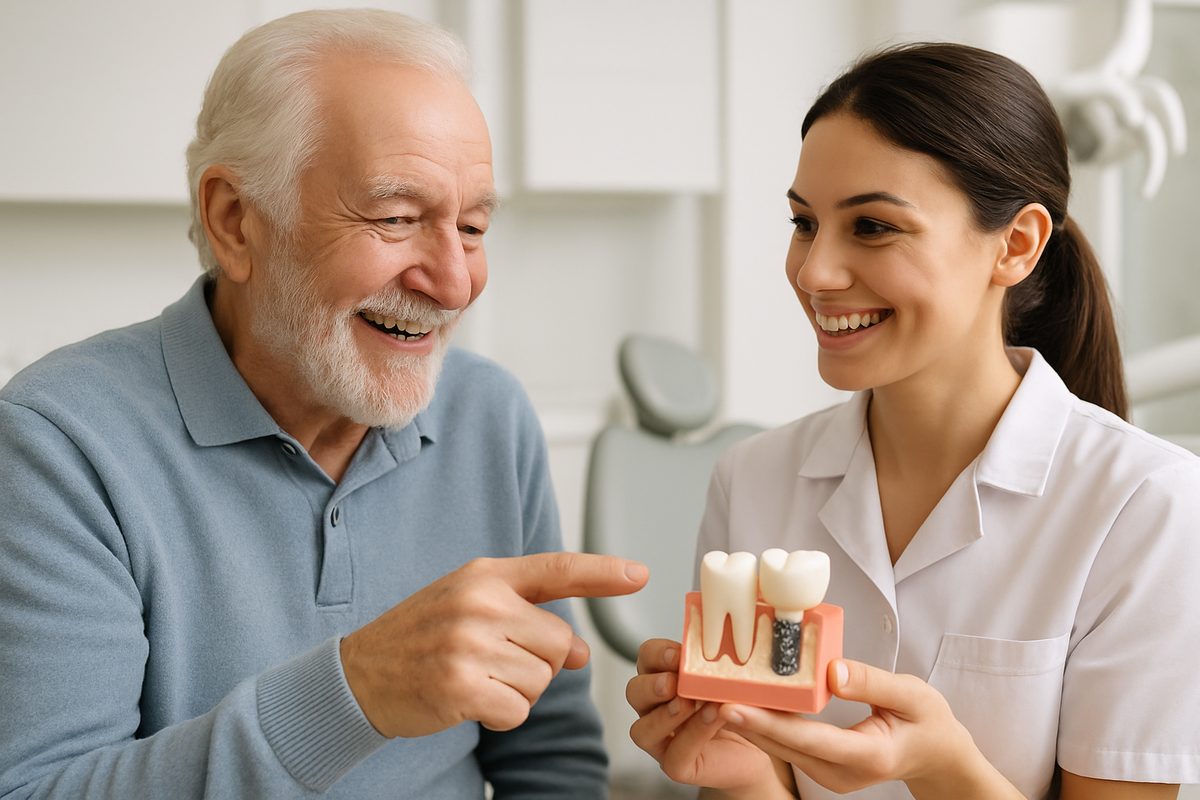
A complete implant restoration usually includes three primary components:
- Implant post: The component surgically positioned in the jawbone.
- Abutment: The connector between the implant and the visible restoration.
- Restoration: A crown, bridge, removable denture, or fixed full-arch prosthesis that replaces the visible teeth.
After placement, the implant must develop a stable connection with the surrounding bone. This biological healing process is called osseointegration. Once sufficient stability has developed, the implant can support the planned restoration.
How Do Dental Implants Work?
A natural tooth transfers chewing pressure through its root and into the jawbone. A dental implant is designed to provide a similar form of support.
When you bite or chew, pressure travels through the crown and abutment to the implant post. Because the implant is anchored in the jaw, the restoration can remain stable without relying entirely on the neighboring teeth or gum tissue.
Implants can support several kinds of replacement teeth:
- A single implant crown
- An implant-supported bridge
- An implant-retained removable denture
- A fixed full-arch implant bridge
What Are the Benefits of Dental Teeth Implants?
Dental implants may offer functional, cosmetic, and oral-health advantages for appropriately selected patients.
Stable chewing support
Because implants are secured within the jawbone, they can provide greater stability than a restoration that rests only on the gums. This can make it easier to chew a broader variety of foods.
Natural-looking tooth replacement
Implant crowns and bridges are customized for the patient’s bite, available space, tooth proportions, and smile. The goal is to create a restoration that blends with the surrounding teeth and facial features.
Preservation of adjacent teeth
A single-tooth implant generally does not require healthy neighboring teeth to be reshaped for support. By comparison, a traditional bridge commonly depends on crowns placed over the teeth beside the gap.
Support for the jawbone
After a tooth is lost, the bone in that area no longer receives normal stimulation from the root. An implant transfers functional pressure into the surrounding jawbone and may help maintain support in the treated area.
Improved denture stability
Implants can help retain a removable denture and reduce unwanted movement during eating or speaking. Patients comparing implant treatment with conventional prosthetics can review our information about custom removable dentures.
Fixed full-arch options
Several strategically placed implants may support a complete fixed bridge for patients who have lost, or need to replace, an entire upper or lower arch of teeth.
Who Is a Candidate for Dental Implants?
Many healthy adults can be considered for implant treatment. Age alone is not usually the deciding factor. The more important considerations are general health, oral health, available bone, healing ability, and willingness to maintain the restoration.
A potential candidate commonly:
- Has one or more missing or nonrestorable teeth
- Has healthy gums or receives treatment for active gum disease
- Has enough jawbone to support the planned implants
- Can safely undergo a surgical procedure
- Maintains appropriate daily oral hygiene
- Is willing to attend follow-up and maintenance appointments
- Understands the treatment timeline, costs, risks, and alternatives
General health considerations
Your dentist will review your medical history, medications, allergies, previous surgeries, and history of anesthesia complications. Certain health conditions can affect healing or require coordination with a physician.
Factors that may require additional planning include:
- Uncontrolled diabetes
- Immune-system disorders
- Bleeding conditions
- Medications that affect bone metabolism
- Previous radiation involving the head or neck
- Heavy tobacco or nicotine use
Having a medical condition does not automatically prevent implant treatment. The condition may need to be controlled or managed before surgery.
Gum health
Active gum infection can affect the tissues supporting an implant. Patients with periodontal disease may need treatment before implant placement and ongoing professional maintenance afterward.
Learn more about maintaining healthy supporting tissues through our periodontal treatment services.
Available jawbone
The implant needs adequate bone volume and density for support. Bone may shrink after long-term tooth loss or become damaged by infection, trauma, or periodontal disease.
When bone is insufficient, grafting may be recommended to rebuild or preserve the treatment site. The timing depends on the amount of bone needed and the location of the planned implant.
Smoking and nicotine use
Smoking and other nicotine use can interfere with blood flow, tissue healing, and implant integration. Patients should discuss their habits honestly so the dental team can explain the associated risks and recommend appropriate precautions.
Teeth grinding
Severe grinding or clenching can place excessive pressure on implants and restorations. Bite adjustments, restorative design changes, or a protective nightguard may be recommended.
Types of Dental Implant Restorations
The appropriate implant solution depends on the number and location of missing teeth, available bone, desired level of stability, cleaning preferences, and budget.
Single-tooth dental implant
A single implant and crown can replace one missing tooth. The implant is placed within the open space and supports an individual crown without depending on neighboring teeth.
This option may be considered when:
- One tooth is missing or cannot be restored
- The neighboring teeth are healthy
- A fixed replacement is preferred
- Adequate bone and restorative space are available
Implant-supported bridge
An implant-supported bridge replaces several adjacent teeth. Rather than placing one implant for every missing tooth, implants positioned at selected locations support a connected restoration.
This approach may reduce the number of implants needed while avoiding the use of natural teeth as bridge supports.
Implant-retained denture
An implant-retained denture remains removable but connects to implants for improved retention. The denture can be taken out for cleaning while offering greater stability than a conventional removable prosthesis.
The number and position of implants vary according to the arch, anatomy, denture design, and treatment plan.
Fixed full-arch dental implants
A fixed full-arch restoration replaces an entire upper or lower arch with a bridge secured to multiple implants. Terms such as All-on-4®, All-on-X, and full-mouth dental implants are often used when discussing this category of treatment.
Some qualified patients may receive implants and temporary fixed teeth during the same planned surgical appointment. Permanent teeth are generally created after the implants and surrounding tissues have healed.
Full-mouth reconstruction
Patients with extensive tooth damage may need a customized combination of implants, crowns, bridges, periodontal care, and other restorative services. Full-mouth treatment is planned around the condition of the remaining teeth, bite, jaw joints, bone, gums, and facial appearance.
Dental Implants vs. Bridges and Dentures
Dental implants are not the only way to replace missing teeth. The best solution depends on your health, anatomy, preferences, timeline, and financial priorities.
Dental implants
- Supported by the jawbone
- Can replace one tooth, several teeth, or an entire arch
- Do not generally require reshaping adjacent teeth for a single implant
- Require surgery and a healing period
- Need sufficient bone or additional grafting
Traditional dental bridges
- Supported by neighboring teeth
- Do not require implant surgery
- May be completed more quickly in some cases
- Commonly require alteration of the supporting teeth
- Do not replace the missing tooth root
Removable dentures
- Can replace several teeth or a complete arch
- Usually involve a lower initial cost than fixed implant treatment
- Must generally be removed for cleaning
- May move during eating or speaking
- Can also be stabilized with implants
Patients can compare these choices in more detail in our guide to dental teeth replacement options.
The Dental Implant Procedure Step by Step
The complete implant process can take several months, although the length and number of appointments vary. Certain stages may be combined when the patient’s health, anatomy, and implant stability permit.
Step 1: Implant consultation
Your first appointment includes a discussion of your goals, concerns, dental history, medical conditions, current medications, and previous tooth-replacement experiences.
The dentist examines your:
- Remaining teeth
- Gums and supporting tissues
- Bite and jaw relationship
- Available restorative space
- Jawbone and facial anatomy
Step 2: X-rays, CBCT imaging, and digital scans
Three-dimensional cone-beam computed tomography, or CBCT, helps the dental team evaluate bone dimensions and locate important structures such as nerves and sinus cavities.
A digital impression may also be used to record the teeth, gums, bite, and available restorative space. The imaging and scan can be combined during digital treatment planning.
Step 3: Personalized treatment planning
The dentist determines:
- Which teeth can be retained
- How many implants may be needed
- Where the implants should be positioned
- Whether extraction or grafting is required
- Which temporary restoration may be used
- Which final restoration best fits the case
- The estimated timeline and cost
A computer-designed surgical guide may be created to assist with transferring the planned implant positions to the mouth.
Step 4: Tooth extraction when necessary
Teeth that cannot be predictably restored may need to be removed. Depending on the condition of the extraction site, implant placement may occur immediately or after a period of healing.
Immediate placement is not appropriate in every situation. Active infection, limited bone, or inability to achieve implant stability may make staged treatment preferable.
Step 5: Bone grafting when required
Bone grafting can preserve an extraction site or increase bone volume where an implant is planned. Minor grafting may be performed with implant placement, while larger grafts may require time to heal before surgery continues.
Step 6: Anesthesia and sedation
Local anesthesia is used to numb the surgical area. Additional sedation or anesthesia may be considered based on the complexity of treatment, the patient’s medical history, and comfort needs.
Patients with dental anxiety can discuss the available sedation dentistry options during their consultation.
Step 7: Implant placement
The dentist creates access to the jawbone and prepares the implant site according to the digital treatment plan. The implant post is then carefully positioned within the bone.
After placement, the implant may receive:
- A cover screw beneath the gum tissue
- A healing abutment that extends through the gums
- A temporary tooth or prosthesis when immediate loading is appropriate
Step 8: Osseointegration
The implant must heal and form a stable connection with the jawbone. This commonly takes several months, but the timeline depends on the treatment site, bone quality, implant stability, grafting, overall health, and patient habits.
Follow-up appointments allow the team to monitor healing and address any concerns before the final restoration is made.
Step 9: Abutment placement
After sufficient healing, an abutment is attached to the implant. This connector supports the visible crown, bridge, or prosthesis.
If the implant healed beneath the gums, a brief procedure may be needed to expose it. The surrounding tissue may then need additional time to develop the desired shape.
Step 10: Designing the final teeth
A digital scan or impression records the implant positions, surrounding gums, neighboring teeth, opposing arch, and bite. The dental laboratory uses this information to create the final restoration.
The design process considers:
- Tooth shape and proportions
- Restorative material
- Bite contact
- Gum contours
- Speech and lip support
- Cleaning access
- Smile appearance
Step 11: Placing the final restoration
The crown, bridge, or full-arch prosthesis is attached to the implant abutments. The dentist evaluates the fit, bite, appearance, comfort, and ability to clean around the restoration.
How Long Does Dental Implant Treatment Take?
The timeline can range from several months to longer for complex cases. Factors that affect treatment length include:
- The number of implants
- The location of the missing teeth
- Whether extractions are necessary
- The need for grafting
- The condition of the gum tissue
- Initial implant stability
- General health and healing response
- The type of temporary and final restoration
Receiving temporary teeth quickly does not eliminate the biological healing period. Even same-day restorations must be protected while the implants integrate.
What Is Recovery Like After Dental Implant Surgery?
Recovery varies according to the extent of surgery. Common short-term effects include swelling, tenderness, bruising, minor bleeding, jaw stiffness, and fatigue after sedation.
Your post-operative instructions may include:
- Taking medication as directed
- Using cold compresses during the initial recovery period
- Resting and limiting strenuous activity
- Following a liquid or soft-food diet
- Avoiding chewing directly on the surgical area
- Cleaning the mouth according to your dentist’s instructions
- Avoiding smoking and nicotine
- Attending every scheduled follow-up appointment
Foods to eat after implant placement
Appropriate early food choices may include:
- Yogurt
- Applesauce
- Smooth soups
- Mashed potatoes
- Soft eggs
- Oatmeal
- Soft pasta
- Well-cooked vegetables
- Protein shakes
Avoid hard, sticky, crunchy, or chewy foods until the dental team confirms that the implants and restoration can tolerate additional pressure.
Dental Implant Risks and Possible Complications
Dental implant treatment has possible risks even when carefully planned. These can include:
- Infection
- Delayed healing
- Failure of an implant to integrate
- Injury or irritation involving a nearby nerve
- Sinus-related complications
- Gum recession
- Bone loss around an implant
- Loosening of an abutment or restorative screw
- Chipping or fracture of the restoration
- Food trapping around the prosthesis
- Changes in speech or bite
- The need for additional treatment
Accurate imaging, careful case selection, appropriate implant positioning, and consistent follow-up care can help reduce risk but cannot eliminate it completely.
When Should You Contact Your Dentist?
Contact the dental office promptly if you experience:
- Bleeding that does not improve
- Pain or swelling that becomes significantly worse
- Fever or symptoms of infection
- Persistent numbness beyond the expected period
- Drainage or an unusual taste from the surgical site
- A loose healing component or restoration
- A sudden change in your bite
- Difficulty breathing or swallowing
- An unexpected reaction to medication
How Do You Care for Dental Implants?
Implant restorations cannot develop cavities, but plaque and bacteria can still cause inflammation and bone loss around them. Consistent home care and professional maintenance are essential.
Long-term care generally includes:
- Brushing at least twice daily
- Cleaning between implants and neighboring teeth
- Cleaning beneath implant bridges when applicable
- Using floss, interdental brushes, or a water flosser as recommended
- Attending regular examinations and professional cleanings
- Wearing a protective nightguard when prescribed
- Avoiding chewing ice and other extremely hard objects
- Reporting bleeding, discomfort, movement, or bite changes
Your dental team may recommend specialized cleaning tools according to the design of your crown, bridge, denture, or full-arch restoration.
How Long Do Dental Implants Last?
Dental implants are designed for long-term use, but no implant or restoration can be guaranteed to last for life.
Longevity depends on several factors:
- Daily oral hygiene
- Gum and bone health
- Smoking or nicotine use
- Medical conditions
- Implant position
- Bite pressure and grinding
- Restorative materials
- Professional maintenance
The implant post and visible restoration also have different maintenance needs. A crown, bridge, attachment, or retaining screw may eventually require adjustment, repair, or replacement even when the implant remains integrated.
How Much Do Dental Teeth Implants Cost?
Dental implant cost varies because treatment is customized. A single implant crown has different requirements from an implant-supported denture or fixed full-arch restoration.
Factors that influence cost include:
- The number of missing teeth
- The number of implants required
- Diagnostic imaging and digital planning
- Tooth extractions
- Bone grafting or sinus procedures
- The implant and abutment components
- The type and material of the final restoration
- Anesthesia or sedation
- Laboratory services
- Temporary restorations
- Follow-up and maintenance care
Patients should request a written, itemized estimate showing which stages are included. Visit our dental implant cost and affordability page for more information.
Does Dental Insurance Cover Implants?
Coverage varies significantly among insurance plans. Some policies may contribute toward examinations, imaging, extractions, grafting, crowns, or other portions of treatment, while others limit or exclude implant benefits.
Important considerations include:
- Annual plan maximums
- Waiting periods
- Missing-tooth clauses
- Deductibles and coinsurance
- Preauthorization requirements
- Coverage for alternative treatments
A benefits estimate is not a guarantee of payment. Patients remain responsible for charges not paid by their plan.
Dental Implant Financing Options
Qualified patients may be able to divide treatment expenses into monthly payments through third-party financing. Health savings accounts or flexible spending accounts may also be useful for eligible expenses.
Before beginning treatment, ask about:
- Available financing providers
- Approval requirements
- Interest rates and promotional periods
- Monthly payment estimates
- Down-payment requirements
- Phased-treatment possibilities
Review Harmon Dental Center’s insurance and dental financing information to explore available payment resources.
How Advanced Technology Supports Implant Treatment
Modern technology helps coordinate diagnosis, implant placement, restorative design, and laboratory fabrication.
CBCT three-dimensional imaging
CBCT imaging provides detailed views of the jawbone, tooth roots, nerves, sinus cavities, and other anatomical structures. These images help the dental team evaluate bone and plan implant dimensions and positions.
Digital impressions
Intraoral scanning creates a digital model of the teeth and gums without relying entirely on traditional impression material. Digital records can be used to plan restorations, create surgical guides, and communicate with the laboratory.
Guided implant planning
Digital implant planning allows the proposed implants to be evaluated in relation to the jawbone and future teeth. A custom surgical guide may then assist with reproducing the plan during surgery.
In-house milling and 3D printing
Milling and 3D-printing technology can support the fabrication of models, guides, temporary restorations, and selected restorative components.
On-site dental laboratory
An in-house laboratory can support direct communication between the clinical and technical teams. It may also make certain design changes and adjustments more efficient.
Learn more about the practice’s capabilities on our state-of-the-art dental laboratory page.
How to Choose a Dental Implant Provider
Dental implant care combines surgical planning, restorative dentistry, bite management, laboratory work, and long-term maintenance. Ask prospective providers how these stages are coordinated.
Helpful questions include:
- How often do you perform dental implant procedures?
- What implant and restorative training have you completed?
- Do you use three-dimensional CBCT imaging?
- Who will perform the surgical and restorative stages?
- Which implant system will be used?
- Who will design and fabricate my final teeth?
- What happens if bone grafting is required?
- Which anesthesia or sedation options are available?
- How many appointments should I expect?
- What follow-up care is included?
- What maintenance will the restoration require?
- Can I receive a written treatment plan and itemized estimate?
Patients can learn more about Dr. Bradley Harmon’s background and approach to patient care.
Why Choose Harmon Dental Center for Dental Implants?
Harmon Dental Center provides implant planning, surgery, restorative care, and laboratory support in one Louisville practice. Treatment is personalized according to the patient’s oral health, anatomy, comfort needs, and restorative goals.
Available implant resources include:
- Three-dimensional CBCT imaging
- Primescan® digital impressions
- Digital implant planning
- Primemill® in-office milling
- In-house 3D printing
- An on-site full-mouth implant laboratory
- Private surgical facilities
- Multiple sedation options
- Customized implant restorations
Coordinating several stages of care within one practice can support communication, convenience, and consistency throughout treatment.
Frequently Asked Questions About Dental Teeth Implants
Are dental teeth implants painful?
Local anesthesia is used to numb the surgical area. Patients may feel pressure or vibration during treatment but should not experience sharp pain. Tenderness, swelling, and soreness can occur during recovery.
Can dental implants replace all my teeth?
Yes. Multiple implants can support a fixed full-arch bridge or help retain a removable denture. The appropriate design depends on your health, jawbone, goals, cleaning preferences, and budget.
Can I receive temporary teeth on the day of surgery?
Some patients may qualify for an immediate temporary restoration. This depends on implant stability, bone quality, bite forces, and the overall treatment plan. The first teeth are generally temporary while the implants heal.
Do I need a bone graft?
Not every patient needs grafting. A graft may be recommended when the existing bone cannot safely support the planned implant or when preserving the treatment site may improve future options.
How long does osseointegration take?
Osseointegration commonly requires several months. Healing time varies according to the location, bone density, implant stability, grafting, general health, nicotine use, and pressure placed on the implant.
Can older adults receive dental implants?
Many older adults can qualify. General health, healing capacity, bone support, and ability to maintain the restoration are usually more important than chronological age.
Can smokers get dental implants?
Smokers may still be evaluated, but nicotine use can increase healing and implant-related risks. Reducing or stopping tobacco and nicotine use may be recommended before and after treatment.
Can dental implants get cavities?
The implant and artificial restoration cannot decay like a natural tooth. However, plaque can still cause inflammation and bone loss around the implant, making daily cleaning and professional care essential.
Are dental implants removable?
Individual implant crowns and fixed bridges are not removed by the patient. Implant-retained dentures are designed to be removable for cleaning.
What happens if an implant fails?
The implant must be evaluated to determine why integration or support was lost. Treatment may involve removing the implant, allowing the area to heal, grafting the site, replacing the implant, or selecting an alternative restoration.
Prepare for Your Dental Implant Consultation
Bring the following information to your first appointment when available:
- A current medication list
- Relevant medical diagnoses
- Information about allergies
- Recent dental X-rays or treatment plans
- Your dental insurance information
- A list of questions and treatment priorities
During the consultation, ask about the recommended number of implants, preparatory procedures, expected timeline, temporary teeth, final restoration, risks, maintenance, total estimated cost, and financing.
Schedule a Dental Implant Consultation in Louisville, KY
Dental implants can provide solutions for a single missing tooth, several missing teeth, loose dentures, or complete tooth loss. A personalized evaluation is the best way to determine which option may support your health, comfort, and smile goals.
Take the first step toward a stable and confident new smile. Contact Harmon Dental Center or call (502) 325-3994 to request your dental implant consultation in Louisville, KY.